Crypto · BBC Stocks
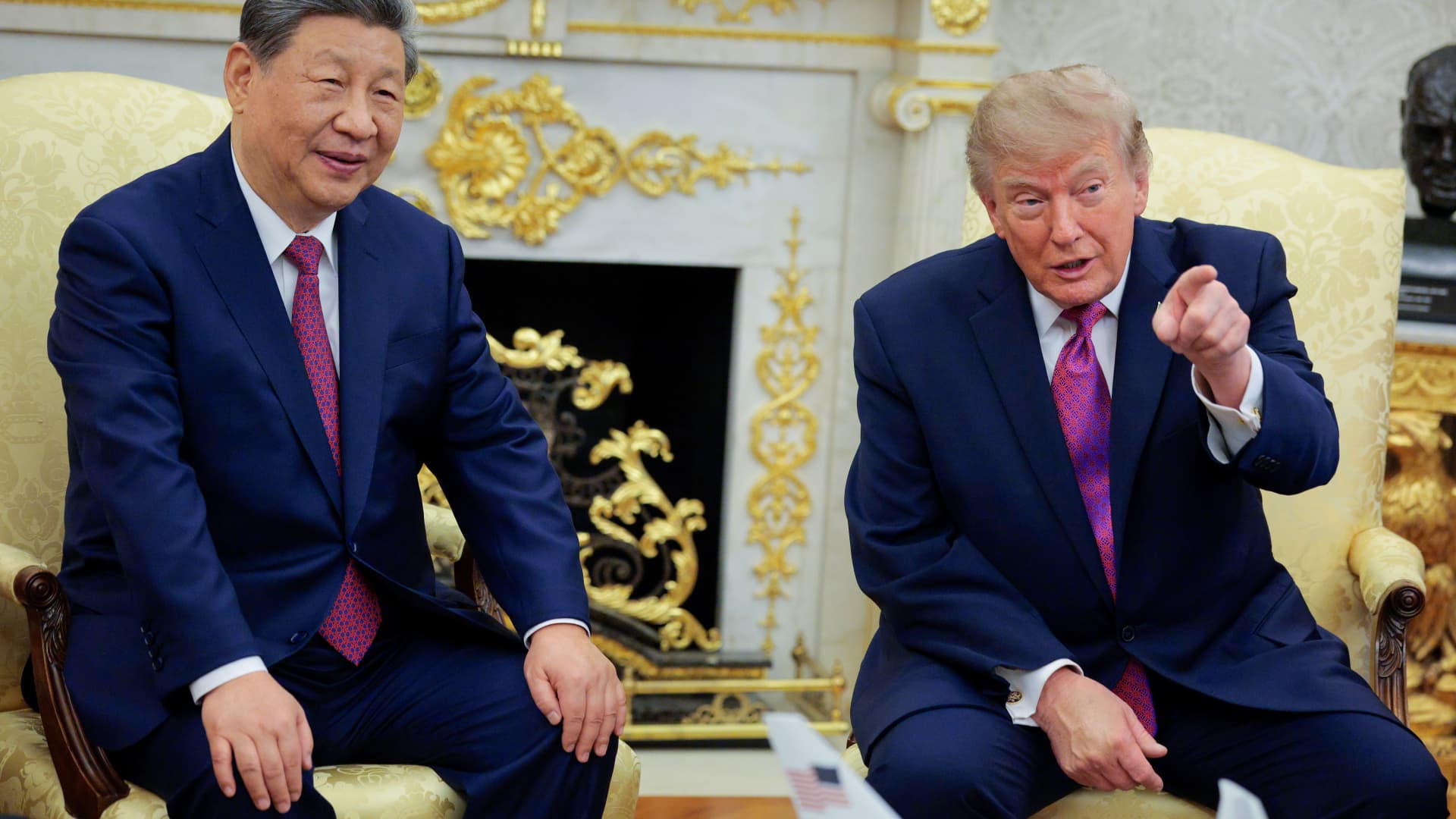
President of China Xi Jinping sit swith U.S. President Donald Trump in the Oval Office at the White House on September 24, 2026 in Washington, DC. Chip Somodevilla | Getty Images Trade tensions between the U.S. and China may resurface in 2027 as a Democrat-controlled Congress tightens chip export controls, economists told CNBC, ahead of a closely watched meeting between U.S.
President Donald Trump and China's Xi Jinping. Former Nvidia CEO Jensen Huang's alleged affair with a woman suspected by the U.S. intelligence to be a Chinese spy has already led to efforts seeking stricter curbs on tech exports. In the U.S.' first policy response to the Huang scandal, the Commerce Department on Monday took steps to close a loophole that has allowed Chinese companies to access Nvidia's advanced computing power from data centers in third countries.
Beijing has yet not issued a response to the U.S. move that comes ahead of the Trump-Xi meeting on Thursday. "Jensen-Gate" may accentuate the tensions and reinforce bilateral posturing but does not constitute a "tectonic shift," said Vishnu Varathan, head of economics and strategy at Mizuho Bank. The world's top two economies have seen improvement in relations since Trump and Xi reached a trade truce last year, meeting on the sidelines of the Asia-Pacific Economic Cooperation summit.
The number of times the two leaders have met, and plan to meet, this year does signal movement in a positive direction, said Ben Emons, managing director at Highline Asset Management. Now as they prepare to engage at APEC again, does "Jensen-Gate" risk hurting that relationship materially? "Our base case is that it won't derail the leader-level relationship in the near term," said Ben Emons, managing director at Highline Asset Management, in an emailed response to questions.
"The bigger risk is that it gives Congress a reason to tighten tech controls over the next 6–12 months." Both Beijing and Washington need a win but that's far from assured. At stake is China's tech manufacturing export boom supporting an otherwise uneven domestic economy that remains mired in deflation, sluggish consumer confidence and a property market that's yet to stage a durable recovery. President Trump and top trade policy officials are looking to extend a trade truce beyond Jan. 10, amid cost-of-living challenges caused by the Iran war that cost the governing Republican Party the Midterms and ceded control of Congress to the Democrats.
Congress concerns The Huang scandal and the Midterm losses could, however, complicate the temporary U.S.-China trade and tariffs deal, with lawmakers asking for tougher tech curbs. "Post-Midterms dynamics give Congress (especially Democrats) more leverage to press for harder export controls or to criticize any perceived softness," said Alicia Garcia Herrero, chief economist for Asia Pacific at Natixis. "Markets have largely treated the truce as durable stability; the risk of renewed escalation if compliance disputes, political pressure, or the Huang investigations intensify is real." The rise of tough-on-China policy hawks on Capitol Hill is not lost on Beijing.
An article in state media China Daily on Monday noted the political firestorm surrounding Nvidia soon after the Midterms is "considerably more" than a company or the conduct of its former chief executive. "Its timing, the congressional reaction and the legislative ambitions now gathering momentum in Washington point to a larger objective: building political support for tougher high-tech restrictions against China." Highline's Emons defined a 'smoking gun' scenario as "a confirmed [China] Ministry of State Security link plus evidence that chips were diverted." Should that materialize, "that would most likely push Congress toward veto-style review of chip sales. Beijing's answer would come through rare earths and its own export controls.
I'd put that at roughly 20–25% over six months. That's low, but it isn't priced," Emons said. Chris Miller, associate professor of international history at The Fletcher School, Tufts University, said "if they find malpractice, Congress is likely to pass legislation that Beijing does not like." Leading Trump administration officials together with Republicans and Democrats in Congress are "laser focused on this question of tech export controls," Miller told " Squawk Box Asia " on Monday, adding that chips and chip-making equipment could face "intensified restrictions over the coming months." What many trade policy watchers find ironic is that China has held off from approving purchases of Nvidia H200 chips to build domestic chip self-reliance even after Washington cleared their exports.
That illustrates how "Beijing needs Nvidia less than Nvidia needs China," Highline's Emons said.
Source: CNBC